Improv at Work: Brainstorming
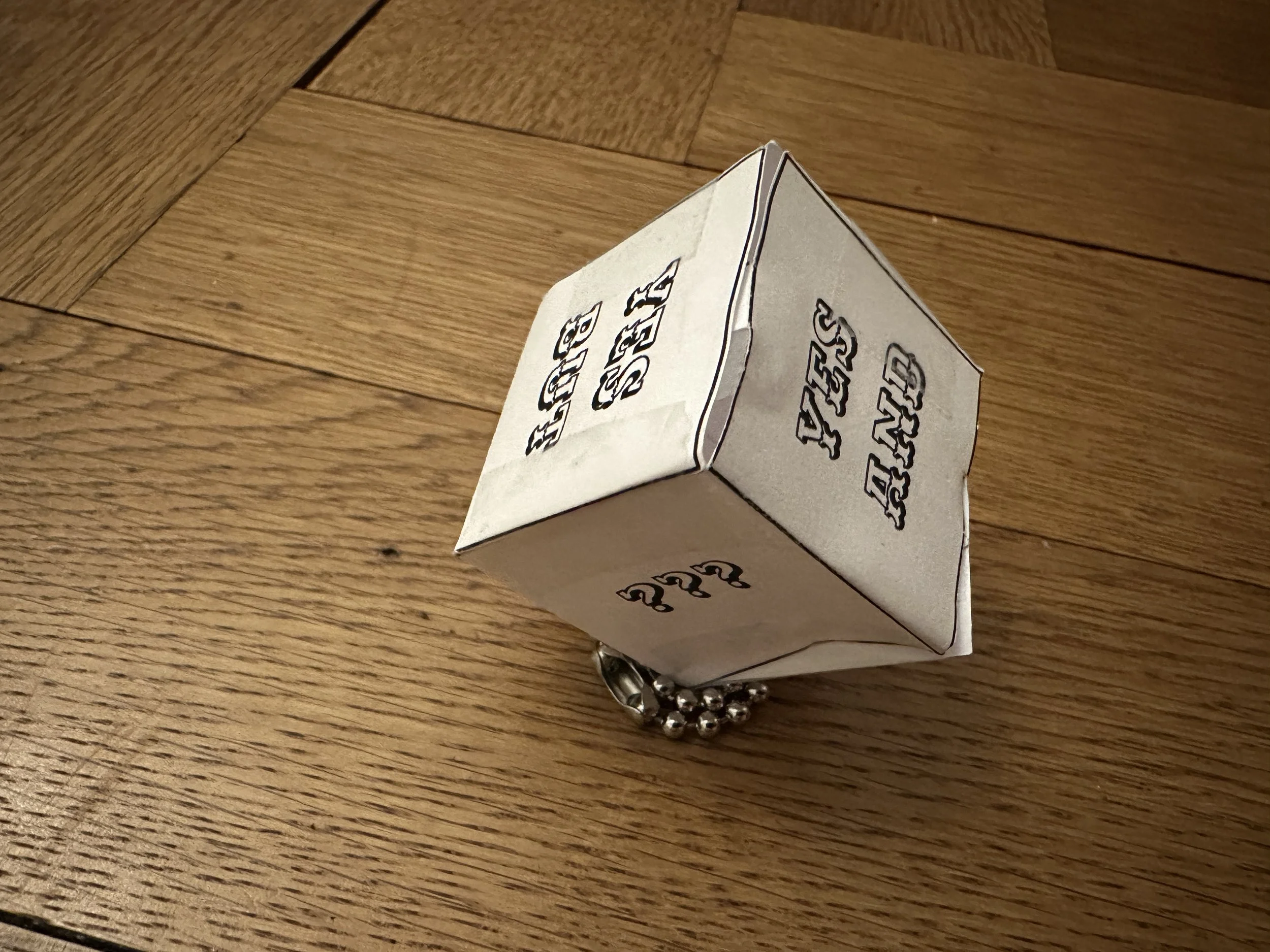
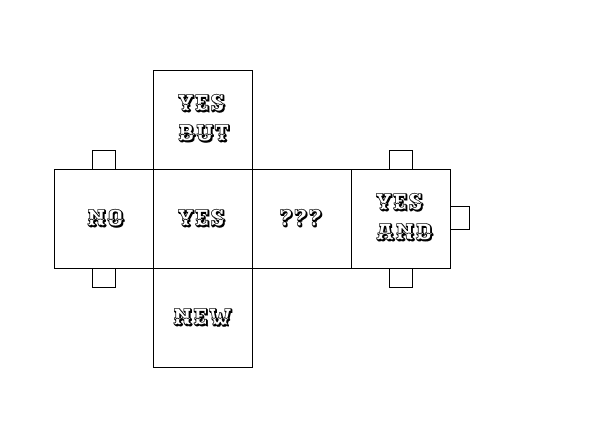
A hastily-made dice to use in an improv class exercise
I’m really interested in how the skills honed practicing improv comedy can be applied at work, a topic I’ve written about previously.
Specifically: the kind of creative pursuits that a UX person or Product Manager might be involved in. Beneath all of the fun, and occasional silliness, of improv, I’m convinced that there a core, transferrable skillset that translates well into fostering creativity amongst the daily grind of meetings, communication, and coordination.
I recently gave a somewhat experimental improv session with the theme “Improv at Work.” (The “… at Work” doing double duty to mean put into service as well as in the workplace, though I fear now that by explaining it, I’m robbing it of whatever little cleverness it had to start). The idea was to use “Work,” and the kinds of situations one finds themselves in there, as a filter to focus on the specific improv skills one might find useful in such an environment.
Yes And
The initial spark for this idea came from the not-very-novel insight that not only is “Yes And” one of the cardinal tenets of improv, but it also ranks highly on most “rules of brainstorming” (along with stuff like “Quantity over Quality” and “Don’t Judge Ideas”). I started to think that if improv and brainstorming had this in common, what other kinds of things might they also have in common?
I first thought about the “Six Thinking Hats,” a framework in which ‘directions’ of thinking (metaphorically represented as hats) can be adopted to examine a situation or problem from different angles. For example, the white “hat” represents fact-based thinking, while the red one is more emotionally-driven. Used in various combinations and programs, these thinking hats can help groups coordinate their thinking and achieve goals faster. I liked the idea of giving improv players an attitudinal ‘direction,’ but these six just didn’t seem quite right; what does it mean to play improv in a fact-based way?
Inspired by this core idea of “Yes And,” I came up with a list of six “attitudes” that players could adopt during a brainstorming scene, to explore how they impacted the scene.
The Exercise
So here’s how the exercise goes:
This exercise is suitable for a group of four to six people.
Each person in the group has a dice (or similar) which will be used to randomly assign an attitude (described in further detail below).
To start, each person rolls the dice to get an “attitude” but doesn’t show this to the other players in the group
The group gets a made-up (hopefully fun!) topic to brainstorm
Take ~5 min to brainstorm the topic as a scene. Every minute or so, players roll their die to assign themselves a new attitude. Keep the scene (i.e. the brainstorm) going across attitude changes.
The Attitudes
Yes And — The classic. Agree with your scene partners and build on their idea.
Yes — Agree with an idea, but don’t really add anything to it.
Yes But — Appear to agree with another player but really contradict them.
Question — Ask a question, leaving another player to answer it
No — Disagree with what another player has said
New — Neither agree or disagree with what another player has said; put a new idea out there
An example
That might all seem a bit abstract, so let’s go through a concrete example of how this might play out in a scene.
Let’s imagine that the brainstorm topic assigned to this group is something like Find New Commercial Uses for Switzerland’s Vast Network of Mostly Unused Bunkers.
Someone starts by saying:
“I think we should rent them out for music practice.”
A player with the Yes attitude might chime in
“Yeah, music practice. Great idea.”
And then a Yes And player might add
“Yes, and people can store their instruments there when they’re not using them!”
The Yes But player seems to support the idea then pivots:
“Yeah, cool. But so many people play an instrument. They’d be be better for raves.”
The Question player asks, not adding much to the conversation:
“Do we know anything about how sound-proof they really are?”
And the New player has another idea completely:
“Eh, what about haircuts?”
And finally, a player with the No attitude
“No way. Too much hair in a confined space can be explosive.
Why this exercise?
Forcing players to respond to their scene partners in a certain way is a valuable way to simulate the kinds of interactions we may have in a real work environment. (The improv stage, of course, being a psychologically safe space to explore these attitudes with very little at stake). I think that we all – knowingly or unconsciously – might get stuck in one of these attitudes or another in our work interactions, and there’s a lot of value in being aware of these patterns. How does it feel when one of your suggestions is merely accepted vs. accepted and built upon? Or for your suggestion to be met with a skeptical question? What effect does it have on you when your idea slips by, unacknowledged, as someone else adds their idea on top of it? What’s the impact on you of continually shooting down everyone else’s ideas?
Even if the kinds of topics you deal with in your workplace aren’t related to bunker reallocation, a heightened awareness of one’s own patterns, with minor adjustments where needed, might help make brainstorms and other group ideation or coordination activities a bit more productive.
Bonus Content: Brainstorm Ideas
For fun, here are some ideas to brainstorm:
Attractions for Salad World (a new salad-themed theme park)
Redesign your country’s flag
Taco Bell’s Christmas-themed menu items
New-to-the-world articles of clothing
Novel renewable energy sources
Etc….
Of course feel free to make up your own! As long as it’s goofy, low-stakes and accessible for everyone. This is still essentially an improv game so it should be fun.
Bonus Bonus Content: Yes-And Brainstorm Dice
You can use a overly complicated dice like this one I made, or just be smart and get a few actual dice and map the values (1-6) to the attitudes above.